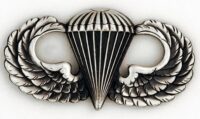
 The iconic U.S. Army Parachutist Badge—commonly known as “Jump Wings”—is one of the most recognizable symbols of elite military service in World War II. Worn proudly by airborne soldiers, the badge represented not only qualification as a parachutist, but also courage, discipline, and a willingness to volunteer for one of the most dangerous forms of warfare of the era.
The Birth of the Parachutist Badge
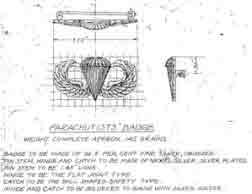 The first Parachutist Badge was designed in 1941 by Captain William P. Yarborough, a member of the 501st Parachute Battalion, who would later rise to the rank of Lieutenant General. His work helped establish not only the badge itself, but also the identity and pride of the U.S. Army’s newly formed airborne forces.
According to a memorandum written by Yarborough on April 22, 1941, the creation of the badge began when he was ordered to Washington, D.C., on March 3, 1941. His mission was clear: design and procure a parachutist badge that would meet the approval of both the War Department and the leadership of the 501st Parachute Battalion.
Before departing, Major William M. Miley, commander of the 501st, granted Yarborough full authority to approve any design he deemed acceptable. This authority was also extended in the name of the Chief of Infantry, giving Yarborough unusual autonomy for such an important symbol.
Designing an Airborne Icon
Yarborough began sketching ideas almost immediately. The original concept was drawn in the office of Lieutenant Colonel Beuchner (G-3), and after numerous iterations and refinements, a final design emerged: a parachute flanked by stylized wings, symbolizing both descent from the sky and mastery of airborne operations.
A finished rendering of the design was prepared by the Office of the Quartermaster General, with assistance from A.E. Dubois. Once approved, production moved with remarkable speed.
Within just eleven days of Yarborough’s initial assignment, 350 badges were manufactured by the prestigious Bailey, Banks & Biddle Company in Philadelphia and delivered to the 501st Parachute Battalion by March 14, 1941. Yarborough himself noted that this was likely a record for War Department procurement speed.
He personally carried the approval paperwork from office to office, spending an entire week ensuring the badge was officially authorized—eight hours a day—demonstrating the importance placed on this symbol from the very beginning.
Patent and Protection
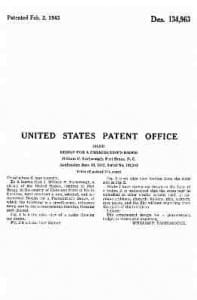
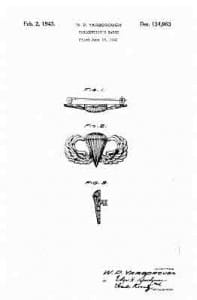 Recognizing the significance of the design, Yarborough took steps to protect it from unauthorized reproduction. On February 2, 1943, he was granted Design Patent #D134,963 for “A Parachutist’s Badge.” The patent remained in effect for three and a half years, helping preserve the integrity of the badge during the war.
A Symbol Earned in Combat
The Parachutist Badge quickly became a mark of distinction. To earn the wings, soldiers had to complete rigorous airborne training, including multiple qualifying jumps from aircraft. These were not ceremonial achievements—each jump carried real risk, especially with the equipment and aircraft of the early 1940s.
During World War II, airborne troops wearing Jump Wings participated in some of the most critical operations of the war, including:
- Operation Torch (North Africa, 1942)
- Operation Husky (Sicily, 1943)
- Operation Overlord (Normandy, 1944)
- Operation Market Garden (Netherlands, 1944)
- The Battle of the Bulge (Belgium, 1944–45)
For these men, the wings represented more than qualification—they symbolized elite status, unit pride, and a shared bond forged through some of the most dangerous missions of the war.
Design and Meaning
The design of the Parachutist Badge is both simple and powerful:
- Parachute: Represents airborne insertion and the unique role of paratroopers
- Wings: Symbolize flight, skill, and the elite nature of airborne forces
Over time, additional devices—such as combat stars or wreaths—would be added to denote advanced qualifications and combat jumps, further enhancing the badge’s significance.
The Legacy of WWII Jump Wings
Today, the WWII-era Jump Wings remain one of the most respected and recognizable military insignia in the world. They are still awarded to qualified paratroopers in the U.S. Army, maintaining a direct lineage back to the original design created by Captain Yarborough in 1941.
For collectors, historians, and airborne enthusiasts, original WWII Jump Wings are highly prized artifacts. They represent not only military qualification, but also the courage of the men who stepped out of aircraft into darkness, uncertainty, and combat.
Why Jump Wings Still Matter
The U.S. Army Parachutist Badge stands as a lasting symbol of innovation, determination, and elite service. Born in the early days of America’s airborne forces, it helped define a new kind of soldier—one trained to fight from the sky.
From the first jumps of the 501st Parachute Battalion to the night skies over Normandy, the Jump Wings represent a legacy of bravery that continues to inspire generations today.