
1940 — Britain Tightens Wartime Controls as France Fights for Survival
By June 6, the British government bans the production of hundreds of household goods as the nation redirects materials and industry toward the war effort. All Germans and Austrians living in the United Kingdom are ordered to surrender their wireless sets, a security measure intended to prevent unauthorized communications during a time of growing invasion fear.
German air raids strike along parts of the east coast of England. At sea, U-46 sinks the British armed merchant cruiser HMS Carinthia off the west coast of Ireland.
In France, German armored forces break through the French line in two places along the Somme front. German tanks, advancing in groups of 200 to 300, smash through defensive positions. Erwin Rommel’s 7th Panzer Division, advancing west of Amiens, penetrates roughly 20 miles into French territory.
The breakthroughs come at a cost. German units suffer heavy losses near Amiens and Péronne, but the momentum of the Blitzkrieg continues to drive the French Army backward.
1941 — Hitler Issues the Commissar Order
Adolf Hitler issues a directive for the implementation of the Kommissarbefehl, or Commissar Order. The order calls for the summary execution of Soviet political commissars attached to the Red Army during the coming invasion of the Soviet Union.
The order reflects the ideological nature of Hitler’s planned war in the east. Although some German units carry it out, many German army and corps commanders quietly resist or ignore the directive, viewing it as contrary to traditional military practice.
In the United States, legislation authorizing the acquisition of idle foreign merchant ships is approved, strengthening America’s ability to support Allied shipping and wartime logistics before formal entry into the war.
1942 — Lidice Destroyed After Heydrich’s Death
A German bomb in Britain, undiscovered for 13 months, explodes. The blast kills 19 people, injures more than 50, and leaves approximately 300 families homeless.
In occupied Czechoslovakia, German forces carry out one of the most infamous reprisals of the war. In response to the assassination of Reinhard Heydrich, German troops destroy the village of Lidice in Bohemia. Every male resident is executed, women and children are deported, and the village is set on fire and erased as a warning to others.
1944 — D-Day: Operation Overlord Begins
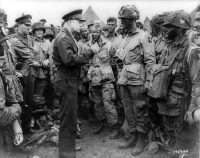 Before dawn on June 6, 1944, the Allied Expeditionary Force begins Operation Overlord, the long-awaited invasion of German-occupied France.
British, American, Canadian, Polish, and Free French forces cross the English Channel and land along the Normandy coast. The invasion beaches are code-named Sword, Juno, Gold, Omaha, and Utah.
Airborne Forces Lead the Way
Before the seaborne landings begin, Allied airborne troops drop behind German lines. The British 6th Airborne Division lands near Caen, while approximately 12,000 paratroopers from the American 82nd Airborne Division and 101st Airborne Division drop onto the Cotentin Peninsula.
On the evening before the invasion, General Dwight D. Eisenhower speaks with members of the 101st Airborne Division. Many of those men will be among the first Allied soldiers to enter France by air.
The Normandy Landings
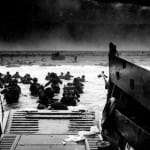 After intense naval and aerial bombardment, the first assault waves go ashore. In all, approximately 156,115 Allied troops land in Normandy on D-Day.
The invasion is supported by a massive armada: 1,213 warships, including battleships and cruisers, more than 1,600 auxiliary vessels, and over 4,000 landing craft. Allied air forces fly more than 14,000 sorties in support of the operation.
German defenders, occupying bunkers, strongpoints, and beach defenses, include roughly 50,000 troops from five infantry divisions, supported by tanks and assault guns. Despite resistance, confusion within German command and the scale of the Allied assault prevent a coordinated response.
Omaha Beach
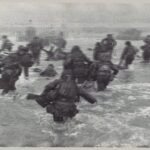 The heaviest American casualties occur at Omaha Beach, where U.S. troops face steep bluffs, strong German defenses, and deadly fire from prepared positions. Despite the chaos and losses, American soldiers push inland and secure a foothold.
By nightfall, most Allied objectives have been reached or partially secured. The invasion has succeeded. A permanent Allied foothold now exists in France.
Elsewhere on June 6, 1944
The Royal Navy loses the destroyers HMS Wrestler and the Norwegian destroyer HNoMS Svenner.
In Italy, French forces take Tivoli as the Allied advance north of Rome continues.
At West Point, the Class of 1944 graduates while the Normandy landings are underway. Among the graduates is John S. D. Eisenhower, son of the Allied commander. His request to command a rifle platoon is denied because of the danger that he might be captured by German forces.
Fleet Admiral William D. Leahy visits his hometown of Hampton, Iowa on a publicized “sentimental journey.” The visit forms part of the broader Allied deception effort designed to convince Germany that the real invasion would not occur while such a senior American officer was away from Washington.
1945 — First Anniversary of D-Day
On the first anniversary of D-Day, General Eisenhower orders a holiday for Allied troops in Europe. The war in Europe has ended, but the cost of the campaign remains enormous.
From June 6, 1944 to V-E Day, Allied casualties in the campaign total approximately 776,967, including 141,590 killed.
In the Pacific, the war continues. On Okinawa, Naha Airbase is now being used by Allied forces to strike targets in Japan, bringing the war ever closer to the Japanese home islands.